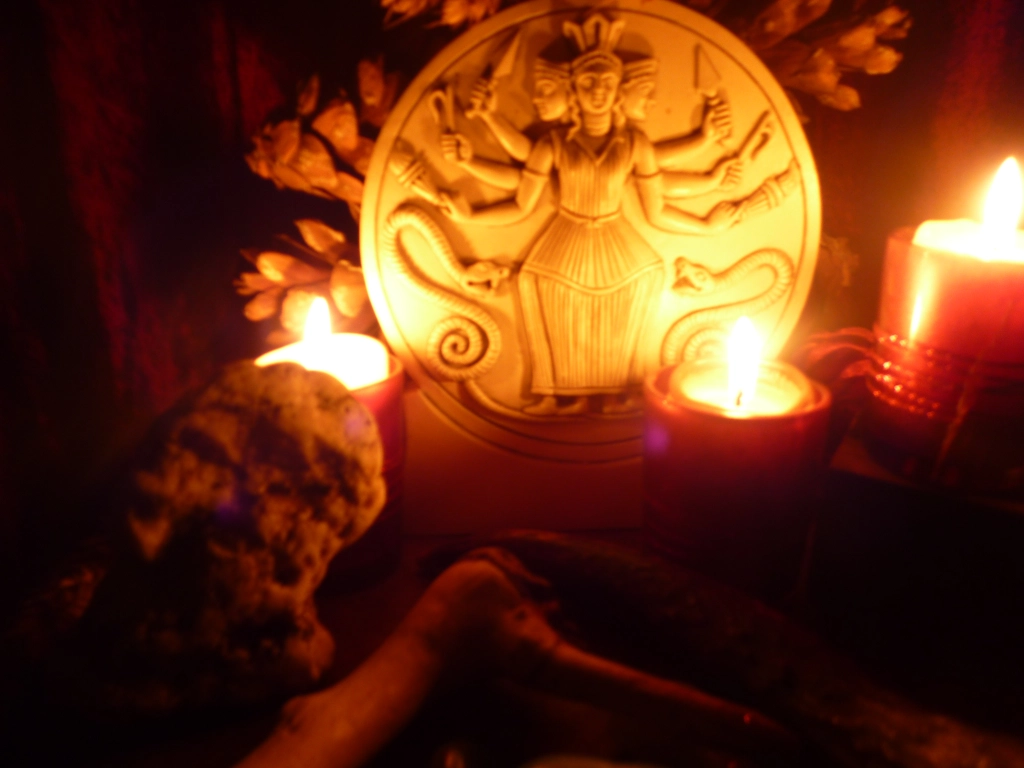
“Wonder what young intruder dares to sing
In these still haunts, where never foot of man
Should treat at evening, lest he chance to spy,
the marble limbs of Artemis and all her company”
(From the “Garden of Eros, 1881)
The Goddess Artemis is a subject I have written and lectured about extensively over the years. One of the most questioned subjects linked to her is that of “virginity”. In modern pagan magical circles the idea of “virginity” is often reinterpreted as being “a woman who has not given birth” or similar, this then fits nicely into the “maiden mother crone” psychological construct which has also become popular in the last few decades. Maybe this is true for some cultural concepts of virginity from a historical perspective, though I would very much like to see some evidence for this. Virginity, like it or not, was prized in many cultures for, amongst other things, its magical potency and other power related reasons. The sacrifice of virginity is something most women remember.
In the myths associated with Artemis, she vows as a child to remain forever a virgin and it is a title which is associated with her throughout the literature of the ancient world; she also illustrates her views through her actions in the various stories which have been recorded. With Artemis however the idea of “virginity” is clearly indicated as being closer to the dictionary interpretation rather than the modern pagan one. It meant no sexual intercourse and there can be no doubt about that.
Virginity was prized amongst her attendants, and Artemis inflicted severe punishments upon those who lost their virginity - regardless of the cause - even when one of the girls were raped by a god, Artemis would usually punish the girl. There were three main Virgin Goddesses amongst the Greek goddesses, in addition to Artemis these were:
Athena: Goddess of Wisdom
Hestia: Goddess of the Hearth
Together, Artemis, Athena and Hestia had immunity from the powers of the Goddess of love, Aphrodite. Homer wrote that the laughter-loving Aphrodite could never tame Artemis in love, saying that the huntress loved archery and slaying of wild beasts in the mountains. Likewise, Artemis was also immune against the arrows of love from Eros. Sappho went as far as to say that Eros simply never approached Artemis.
Artemis made herself the ultimate unattainable trophy, both as a sworn virgin and as a very effective warrior. It was dangerous for both mortals and gods to attempt to force their adorations on her, but of course this didn’t stop them from trying!
Sometimes Artemis was kind in her dealings with the love sick of the male species. When Alpheios, a river god, fell in love with her, she disguised herself and her attendents when she found out that he was going to attempt to molest her at an all night gathering she was holding with her nymphs. She smeared herself and all the nymphs with mud, so that Alpheios would not be able to distinguish between them. Frustrated in his efforts to recognise Artemis, he eventually gave up and left.
Whilst Artemis did her best to protect her attendants if their virginity was threatened, she would also punish those who did not defend themselves effectively. She turned the arcadian nymphs Arethousa and Syrinx respectively, into a spring and reeds to save them from losing their virginity, likewise she turned Amethyst into a rock to save her. When the young prince Hippolytus, who had devoted his chaste life to her was killed through the machinatiosn of Aphrodite, Artemis persuaded Asclepius (god of healing) to bring him back to life and he then became a temple attendant at Aricia (in Italy). Thus illustrating Artemis’ connection not just with female virginity, but also with male virginity.
However, when Actaeon, the prince of Thebes has the misfortune of seeing Artemis naked as she bathed in a stream, Artemis did not look kindly on his misfortune. Instead she turned him into a stag and sent his own hunting hounds after him, who killed him very slowly, as a punishment for seeing her naked.
When the king Aristomelidas defiled one of her maidens, Artemis stirred up the hero Khronios to slay the king. After killing the king Khronios, showing a good sense of honour (or fear) set up a sanctuary to Artemis. When the mortal Bouphagos decided to attempt to force himself upon her and take her virginity, he was killed for his sacrilege.
When one of Artemis’ priestesses defiled the sanctity not only of her own body, but also of that of the inner sanctuary of the Temple at Patrai it is obvious that it would not end well. Lomaitho, the priestess of Artemis made love with her lover Melanippos in the temple here, and Artemis was furious. She inflicted punishment on the entire community making the harvests fail and fatal diseases began to afflict one and all. When the Delphic Oracle was consulted the Pythia accused the lovers and ordered their sacrifice to Artemis. Subsequently each year the most handsome young and the fairest of the maidens would be sacrificed to Artemis here. From this the river by the sanctuary gained its name “Ameilikhos” (relentless).
Many other examples exist to illustrate Artemis’ association with virginity and sexual chastity - which is a clear association with her throughout history.
I was reminded of the strong connection between the goddess Artemis and birds this morning, especially swans which were sacred to her brother Apollo and goldfinches, which were sacred to Artemis. In the play “The Birds” by Aristophanes the goldfinch is associated with Artemis, where the Priest says: “Pray to the swan of Delos (Apollo), to Latona the mother of quails (Leto, their mother), and to Artemis, the goldfinch”. Artemis is also shown feeding a swan on a vase image dating to the 5th century BCE.
Having spotted both these birds this morning I feel rather chuffed, but also reminded of the work I did a few years back researching for “Artemis Virgin Goddess of the Sun & Moon“; after the recent publication of “Hekate Liminal Rites” which in a roundabout way was the reason that I also wrote on Artemis. Both these ancient Greek Goddesses are misrpresented so often, to different extremes. Where as Hekate usually suffers from a very distorted “evil old crone” image; Artemis suffers in the opposite direction, where she is usually made out to be nothing but a “happy go lucky moon goddess with a bow and arrow”!
When you gaze a little beyond the surface however, just like with Hekate were we find that she is in fact a Goddess of light, who is given titles such as “lightbearer”; “world soul” and “companion” - illustrating her benevolent nature. So too Artemis who has many positive ephitets hinting at goodness such as “golden throned” and “fairest and most beautiful” and “of good repute”, “the leader” - however, she also has titles and stories associated with her clearly showing her malevolent and much darker side. She is “delighter in arrows” , “golden sworded”, “the strangled lady” and “the thunderer”. Some examples of Artemis’ nature are hinted at even more clearly when one examines the myths and reasons for it being given, rather than just looking at the lists. For example:
Artemis Skythia:
This title is used for Artemis in the Life of Apollonius of Tyana, here he describes the ritual scourging that was done in honour of Artemis. Scourging of course is still used in many modern magical and pagan traditions, the best known example being that of Gardnerian Wicca. However, the use of the scourge in these modern traditions are often symbolic and it is not generally used with the intention of causing pain. For the Goddess Artemis this would not have sufficed, because the scourging that was done in her honour was done until blood was flowing freely and the blood from the wounds wound then be smeared over her altars. Gory as it sounds, this was a replacement for human sacrifice which was also known to happen in honour of this (and many other) goddess, and it was a well known practice at Skythoi previous to this practice of scourging, which was considered to be less babarian!
I will write more about Artemis in future, because I have discovered so much more about this fascinating Goddess over the years since completing Artemis Virgin Goddess of the Sun and Moon, and I am certain that there is still a great deal more to discover. There are so many interconnections also between Artemis and her cousin Hekate, that I may have no choice!
This is an extract from Practical Planetary Magick, written by myself and David Rankine and published by Avalonia. A while ago I posted the Mars meditation, and it was hugely popular with readers on some of the social networking sites I am on - especially on facebook - so I decided to post a couple more extracts from the same book. I hope that if you are reading this, and if you find yourself inspired to spend a few minutes trying out this creative visualisation, you will find it a useful practice.
Creative Visualisation: Luna
Sit comfortably and relax, closing your eyes. In your mind’s eye fix the image of yourself sitting as you are in the room. Hold this image, and then see a white mist filling the room, obscuring the walls, the floor, the ceiling, everything, until all around you is white mist. As the mist disperses you find yourself in a silver chariot pulled through the night sky by four silver horses.
Standing next to you in the chariot is a beautiful woman with long silver hair in a flowing silver dress. As silver light radiates from her you know this is Luna, the moon goddess, travelling her course through the night. Her light dims a little, and as you look forward you see one of the front horses turns black.
You keep looking around, at the stars above, and the dimly lit landscape below, and as you do so her light dims again, and the other front horse turns black. You realise the phases of the moon are reflected through her light and the colour of her horses.
“Understanding the nature of cycles will help you move forward on your path,” Luna tells you, “the ebbs and flows of your own nature and how they respond to your environment.” As she speaks her light dims further, and you know a third horse has turned black. She smiles, and her light fades completely, enabling you to look at her beauty easily. You glance forward and see the chariot is now pulled by four black horses.
Though it is darker now, it is easier for you to see the ground below and the stars above. You realise that the dreamlike quality of this journey is a reflection of the power of the moon, and see a silver light emanating from Luna again, and one of the horses turn silver.
“One of the greatest gifts I give is intuition, always trust yours, for it is there when you have nothing else,” Luna informs you. You thank her and watch enraptured as she becomes brighter and brighter again, regaining her former radiance. As she does so all the horses turn silver one by one. You know this is an endless cycle, and as you watch her, the white mist appears, filling the chariot around you, until once again you are surrounded by white mist. Again the mist disperses, and as it fades away you find yourself once more sitting in your room. Take some time to write up your experience and contemplate what you have learned.
I should probably not be surprised that I am often asked to name some of the Goddess Hekate’s titles. As one of the most complex and interesting Goddesses of the ancient world, and as a Goddess who have been vilified and continues to be put in a box far too small to ever contain her, Hekate has also had many epithets bestowed upon her over the years. In the book Hekate Liminal Rites, we give a short list of the most popular of these titles associated with Hekate, these are:
Chthonia(‘earthly one’),
Dadouchos(‘torch-bearer’),
Enodia(‘of the ways’),
Kleidouchos(‘key-bearer’),
Kourotrophos(‘child’s nurse’)
Phosphorus(‘light-bearer’).
Propolos(‘companion’)
Propylaia(‘before the gate’),
Soteira(’saviour’)
Triformis(‘three bodied’)
Trioditis(‘of the three ways’)
These titles alone shows clearly how contracting her nature can be, but also how there is much more to Hekate than the simpleminded hag goddess some people try and make her into. Hekate’s followers in the ancient world included some of the best known magical practitioners of all time - Circe and Medea; Empedocles, Hesiod, Porphyry and even Sophocles wrote about her and was associated with her, as were the famed witches of Thessally. She was linked even to King Solomon in magical practices!
I know that it is a popular practice in modern paganism to invoke deities based solely on a few characteristics or “archetype” features associated with them, maybe adding a title or two, but for those of you who are seriously interested in this Goddess and wish to work with her, I would suggest a bit more indepth work and study. Yes, throw yourself into the deep end and “just go for it” but make sure that you are also prepared for the consequences - she is sometimes referred to as an “initiatory Goddess” and that is not for nothing! She is a harbringer of change - through both creation and destruction, and it is best advised that you enter into such territory with the necessary equipment!
There a few books on this Goddess which I will always recommend; these are:
Hekate Liminal Rites, by Sorita d’Este and David Rankine (history and sources of practices associated with her)
Hekate Keys to the Crossroads by various contributors, edited by Sorita d’Este (a collection of essays detailing modern day experiential accounts with Hekate)
The Goddess Hekate by Stephen Ronan (a collection of essays on the Goddess Hekate, lots of material on Hekate Soteira, as well as images of Hekate and fantastic translations of various hymns)
Hekate in Ancient Greek Religion by Robert von Rudloff
As both an author and publisher, its difficult at times to maintain an excitement for new books. After all it can at times, like any other job, be like “hard work”. So imagine my surprise when earlier this year a project crossed our way which not only fitted exactly into our catalogue, but which was also well written, exciting and presented a whole host of original ideas. This book “Stellar Magic” by the author Payam Nabarz is now forthcoming from Avalonia and will be available from ourselves, as well as many bookshops from as July! We loved it because it complimented some of our own work so very well, whilst offering a completely new and contemporary look at magical work with the Moon, Planets, Stars and Constellations - providing research, insights, ideas and many full rituals which can be worked by solitary practitioners of magic, as well as groups. In fact many of the rituals would be ideal for groups of people working together who want a structured programme of work, it can be easily adapted and Payam is throrough in his advice, whilst also encouraging a great deal of creativity and flexibility.
Everyone has an opinion when it comes to Angels, Demons and Fallen Angels and this is why I thought it would be great to produce an anthology with essays collected from some of the foremost modern occultists, magicians and researchers on this topic. It would provide a counterpoint to all the fluffy thinking which has been made popular in the last few years about angels, a book on Angels as viewed from a magical perspective through the ages. If I had a huge budget and support team, I could have produced a book a hundred times the size, but instead I asked a handful of people I know have a longstanding interest in and love of angelic beings. I knew that they would have views and experiences which would contradict each other, yet compliment each other - and that they would all be very different, even when on the surface they were writing on the same topic. I was not dissapointed, nor I hope will readers of this unique anthology be. It is out later this week– (see Both Sides of Heaven at Avalonia).
Both Sides of Heaven is a collection of 18 essays, the first of which I wrote to both introduce some of the concepts in the other essays, as well as covering some areas of angelology which the contributors did not touch upon. My essay, A Host of Winged Messengers introduces the beautiful and fascinating web of articles by the contributors which follow. It was a great honour for me to work on this project, which is the fourth anthology I have produced in the last four years - thank you to all the contributors who made this project possible! Each and everyone of you are a star amongst the heavens - which side is up to you!
Its always nice when things happen to make you feel happy and bouncy! Well the last few days has been rather a lot like that, maybe its the Midsummer madness or something to do with the shift of the seasons, but I am feeling rather more excited about the world around me than I have done in a really long time!
There is plenty to be excited about too.
This past weekend, David and I decided to take a mini-break from work and investigate some of the Sheela-na-gig figures in our local area. The weekend before I went to visit Kilpeck again with a couple of friends on the way taking them back to the station (we live 20 + miles from the nearest railway station!). Of course Kilpeck is home to a very famous Sheela, as well as many other interesting figurines carved as corbels around the church. Closer to where we live there is a less known Sheela, sometimes described as a “monkey” though I think its pretty clear that she has just been eroded and possibly even deliberately damaged with time.
(See figure on the right, legs spread like the Sheela-na-gig’s and it looks like she has two breasts,
one of which she is holding on to. The two figures are flanked by two six-spoked designs, interesting
because these are linked to the “Wheel God” a figure which was very popular in Britain - see The Isles of the Many Gods for details - the figure to her left, seems to be male and may have had an exagerated phallus, and there is something which suggests a ram horn, again a popular motiff associated with many early British male deities)
In addition to doing a bit of sightseeing and getting to know this beautiful part of the world a lot better, we have also been hard at work at Avalonia. We have THREE books being released in the next three weeks! The first of these BOTH SIDES OF HEAVEN, edited by and contributed to by yours truly is now available for pre-order from the Avalonia Books website. See http://www.avaloniabooks.co.uk for details. The one thing I enjoy a great deal when I have worked on anthologies in the past (for example Priestesses Pythonesses & Sibyls or Horns of Power ) is that it gives me an chance to be introduced to a variety of traditions and opinions in one place in this exciting format in which different voices and different ideals are brought together with experience and research, but from very different viewpoints. With Both Sides of Heaven this is also true - and I am as much looking forward to hearing back from the writers themselves when they read each other’s essays, as I am from the readers. I am really hoping that it will open some real debate about Angels, Fallen Angels and Demons amongst its readers, and that it will also allow readers to be introduced to the diversity of views, opinions and research being done into this area of esoteric study at the moment.
Finally, for those of you in the USA who have been thinking of buying a copy of the book Wicca Magickal Beginnings - Amazon.com is running a special offer on it at the moment, at just US$16.99 spotted by a reader earlier today.So go grab yourself a bargain - its a great book (and not just for Wiccans, though it is aimed more specifically at Wiccans who have studied in one of the initiatory traditions, or Pagans who draw from the Wiccan tradition and work with salt & water, Circle, Guardians at the four directions etc):
May you have a Happy Sunny Solstice Celebration, with much joy and happiness; (Northern Hemisphere)
May you have a joyful merriment, with much contemplation, love and friendship; (Southern Hemisphere)
———————————————–
For those unfamiliar with the Summer and Winter Solstices, and the associated celebrations, here are short extracts from the overviews provided on these festivals from “Towards the Wiccan Circle” which is a book I wrote based on the material presented in the homestudy course by the same name:
Summer Solstice (Litha) -21st of June
At the Summer Solstice the sun is at its highest and brightest and the day at its longest. The Summer Solstice is a time of fulfilment of love. June was considered by some to be the luckiest month to be married in, and is the time of the mead moon, or honey moon. A tradition was for newly weds to drink mead daily for a month after their wedding, hence the post wedding holiday being named the honeymoon. This is a time of beauty, love, strength, energy, rejoicing in the warmth of the sun, and the promise of the fruitfulness to come. It seems a carefree time, yet in the knowledge of life, is the knowledge of death, and beauty is but transitory. We celebrate life, and the triumph of light, but acknowledge death, and the power of the dark which now begins to grow stronger.
Winter Solstice (Yule) - 21st December
At Yule we say goodbye to the dying Sun, and wait through the long, cold night for the Sun’s rebirth as the Child of Promise. The rising Sun brings the promise of the spring and the gifts that will bring. It is still a long time before the Sun will be strong, but we hope and we trust. Yule is a turning point, a point of change, where the tides of the year turn and begin to flow in the opposite direction. It is the darkest time of the year, the time of the longest night, but there is the promise of the return of lighter and warmer times.
To light the long night people would burn the Yule log. The Yule log would be the last log brought into the home, which would be kept for the next year to begin the Yule fire, until it had burned away and was replaced by another one. As many homes no longer have a hearth fire and it may not be practical to have a fire in an indoors ceremony Wiccans often make a symbolic Yule log for use in ceremonies. This takes the form of a decorated log, with a candle for each person present. The candles are lit by each person in turn as they make a wish for the year to come, thinking of hopes for the coming year, and of setting resolutions. From the darkness comes light.
Of course the seasons are reversed on the other side of the planet, hence whilst we will be celebrating and marking these festivals according to the dates given above, the dates are the other way around in the Southern Hemisphere. For this reason I included both Solstices in this blessing and in the extracts above.
Tuesday is the day attributed to the Roman God Mars, and associated energies and I have made the decision to do a series of blogs on planetary magick over the coming month or two. So in the first of these, I am including a creative visualisation journey, which explores the energies and symbolism associated with Mars. It was first published in “Practical Planetary Magick” which I co-wrote with my husband David Rankine.
Creative Visualisation: Mars
Sit comfortably and relax, closing your eyes.In your mind’s eye fix the image of yourself sitting as you are in the room.Hold this image, and then see a white mist filling the room, obscuring the walls, the floor, the ceiling, everything, until all around you is white mist.
The white mist disperses and you find yourself standing in a grove, in front of a large old oak tree.In your hands you are holding a sword and a round shield.As you look up at the branches of the oak tree you see mistletoe growing on the upper branches.
A rustling in the undergrowth alerts you to the presence of other life and you turn around so your back is to the tree.Stepping from the trees is the tall figure of a warrior bearing an axe.You bang your sword against your shield to draw his attention and he stares pointedly at you.He demands you step out of the way so he can cut the oak tree down.You refuse and explain that the oak is ancient, a sacred tree that supports all sorts of life and is central to the grove it is in.Listening to you, the warrior first shakes his head, and then slowly starts nodding in agreement.When you have finished explaining he takes his axe and walks away back into the woods.
Almost immediately another figure steps from the trees, again carrying a large axe.He also demands you step aside to let him cut down the oak.You refuse and start to explain about the oak, but he ignores your words and runs at you waving his axe.You raise your shield in time and deflect his blow, sending him flying.With an angry grunt he rises and charges again.This time you are more ready and parry his blow, knocking him to the ground again with your shield.You warn him that next time you will draw blood.
The warrior pauses and sizes you up.Realising you are serious, he gives you a nod of respect and walks away.More rustling warns you that another person is coming.As you wait, you see a large attractive and powerful man in a breastplate bearing a sword and shield walking towards you.He stops and hails you, and you realise this is Mars.He speaks to you and says: “You have shown your willingness to fight when you need to, and as a warrior not do more than you need to.Do you always choose your fights as well, and choose your ground appropriately?You should usually be able to win any fight with your mind, and without shaming your opponent.Remember this and the warrior path will always provide you with strength and courage to carry on your way.Hail warrior!”
With this cry, Mars disappears, leaving you considering his words.As you look around you see the white mist rising until once again all around you is white mist.Again the mist disperses, and as it fades away you find yourself once more sitting in the room.Take some time to write up your experience and contemplate what you have learned
Hekate Liminal Rites has only been out there in the hands of readers for just a little more than a week and already we have received two reviews, which I am delighted to say are both very very positive!
The first is from one of the creators of the “God Tarot” Kim Huggens whose review can be read at The Esoteric Book Review - click here - amongst other things she wrote:
Hekate: Liminal Rites has managed to be scholarly and well-researched, without being dense or difficult to read. It does not use obtuse language or jargon that only an ancient professor who lives in a library and can translate twelve different dead languages can understand. Rather, it is aimed at the average person interested in occultism and magic, but does not dumb itself down like so many publications these days. The result of this is that readers have been given a work that can be verified, a work that allows them to do their own research, a work that is a joy to read, and a work that remains on the level without sacrificing academic awareness.
This book has been a wonderful addition to my ever growing library! The historic backgrounds highlighting the many different aspects of Hekate filled in soooooo many blanks for me in the way that she was seen way back in the way back when machine! The intellectual aspects and research that are showcased in the book still feel organic to me, as opposed to many of the other more academic texts that are out there on the subject. This was a very pleasant surprise, and I intend to check out much more by the author. I have fallen head over heels for this book!
And this does give us something to smile about, even though the weather has gone colder again here in the Welsh borders! I am currently working on putting the final touches to the anthology on Angels, Fallen Angels and Demons entitled “Both Sides of Heaven” which is due out for publication later this month. It has already caused a bit of a stir (even though no-one has actually read it, except the Avalonia team!) and so it should, in addition to my own introduction to the book which covers Archangels and gives an overview of other aspects of the material covered, the book includes 17 essays by some of the foremost occult and esoteric writers, researchers and practitioners of the current age. “Angels” are considered from a number of different cultures and perspectives - ranging from their place in the pre-Christian era through to the Enochian Magic of John Dee and modern experiential accounts, a Pagan Magician who works with the Grimoires. More info available very soon, make sure to join the Newsletter Mailinglist at http://www.avaloniabooks.co.uk to be kept informed of new publications, including this one.
For those readers who enjoyed the anthology “Priestesses Pythonesses & Sibyls” ( see http://pythoness.avalonia.co.uk/foreword.htm for details) you may recall the exellent essay “The Seer” by Katie Gerrard. In this essay Katie writes about her experiences and research of Seidr, a trance technique originating from the Norse traditions of magic. Katie has been working with Seidr since the 1990’s researching and experimenting with what information is available on the historical techniques. For the last few years she has been involved in the facilitation of a practical Seidr group in centra Lonon and has also lectured on this and related subjects at national events in the UK.
Well we have just found out that Katie will be facilitating a course in using the Runes at the magical bookshop Treadwells in Covent Garden, London this September. In this workshop she will cover the history of the Galdra, Spellcraft, intoning and making your own set of Runes and it is great oppurtunity for anyone interested in working with the Runes to find out more. Details can be found at Katie’s website “The BirchTree” http://www.thebirchtree.com/page12.htm
I have been working on bringing together some of the best and most interesting work from a diverse selection of modern writers on the subject of Angels, Fallen Angels and Demons. The result is the anthology “Both Sides of Heaven” which will be published by Avalonia later this month. More details will follow soon, in the meantime, I would like to show off the cover for this latest project to be completed, the artwork is by the magical artist Emily Carding, who is also the creator of the Transparent Tarot and the Tarot of the Sidhe. Emily’s artwork has previously featured on the cover of one of my books “Towards the Wiccan Circle”; additionally Emily is also a contributor to this anthology - writing about one of her specialist subjects The Sidhe.To learn more about Emily’s artwork see her website www.childofavalon.com for a few examples.
Following on from my lecture at the Ludlow Esoteric Conference this past weekend (30 May 2009, Ludlow in Shropshire, England), I have had a few requests to publish my talk as an essay. I will have to work on that as I only worked from skeleton notes (I prefer to talk, rather than read notes!) but as soon as I have a spare hour or so I will write an essay based on what I spoke about and publish it somewhere accessable.
In the meantime, for the two ladies who asked, here are the words to the rhyme which was used as the basis for the chant by Doreen Valiente:
Black spirits and white, red spirits and grey
Mingle, mingle, mingle, you that may
Titty, tiffin, keep it stiff in
Firedrake, puckey, keep it lucky
Liard, Robin, you must bob in
Round, around, around, about, about
All ill come running in, all good keep out
From: The Witch, by Thomas Middleton, 17th century.
Please note that all articles and photographs on this website is copyright Sorita d'Este, no part of this site may be reproduced without the express written permission of the author.
(c) Sorita d'Este 1997, 2009